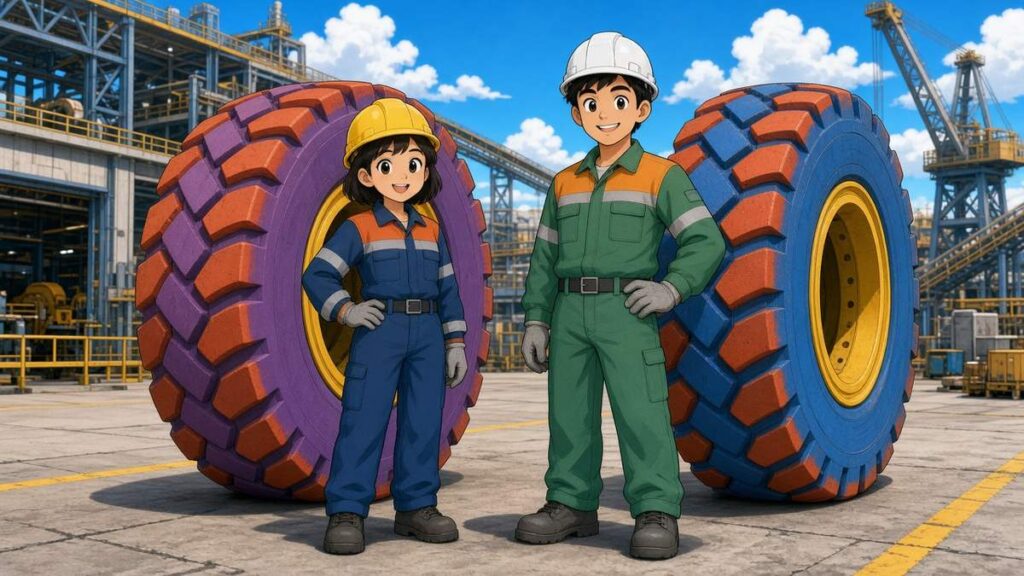
Taller Than Two People, Almost Sold Out: Bridgestone’s Giant Mining Tires Ride the AI Copper Boom
The machines that dig copper for data centres roll on tires taller than two people standing one above the other. At Bridgestone’s plant in Kitakyushu, in Fukuoka Prefecture, those ultralarge tires are now being built at nearly full capacity. The Japanese manufacturer is pointing the factory at a very specific kind of customer: mining companies that supply copper for the servers behind the artificial-intelligence boom.
The works sit in an industrial zone facing the Hibiki-nada sea, about a twenty-minute drive from JR Kokura station. Opened in 2009, it is Bridgestone’s newest tire plant in Japan, and the tires that leave it stand more than twice as tall as an average person.
A factory that never really sleeps
The Kitakyushu plant specialises in off-the-road tires with rim diameters of 49 to 63 inches. The biggest products have an outer diameter of more than four metres and weigh about six tonnes — roughly the weight of 600 ordinary passenger-car tires. Crews keep the lines running around the clock.
Making one of these tires is slow, skilled work. The bead that locks the tire to the wheel contains some 3,000 metres of steel wire. Vulcanisation — the heating and pressing that give the rubber its strength and spring — takes about twelve hours for a 63-inch tire. Finished products are checked with X-rays and ultrasound and then inspected by eye and by hand. Almost all of them, about 99 percent, leave Japan by ship for open-pit mines that dig iron ore and copper.
Why an AI boom shows up as a tire order
New data centres and the shift toward electric vehicles have lifted demand for copper and other minerals. To raise output, mines run their giant dump trucks harder, and the tires that keep those trucks moving wear out faster. Bridgestone is answering that demand not by simply making more tires, but by leaning into higher-margin products. From 2024 it has been investing 25 billion yen to replace equipment at Kitakyushu, a programme due to finish during 2027. The plan keeps overall volume roughly where it is and raises the share of more durable lines such as Bridgestone MASTERCORE.
The arithmetic explains the priority. In 2025 the company’s special-tire business, which includes mining products, brought in 623.4 billion yen — 14 percent of group sales — but 125.5 billion yen of adjusted operating profit, or 25 percent of the total. The profit margin was 20.1 percent, against 10.7 percent for passenger-car and light-truck tires. Market researcher Fortune Business Insights has projected that the global off-the-road tire market will reach 28.19 billion dollars by 2034, about 50 percent larger than in 2025.
That is a different business from the passenger-car market, where cheaper Chinese products keep prices under pressure. A mining tire has to survive rock, heat and enormous loads. If it fails on a remote haul road, a truck that costs far more than the tire sits idle. Durability, not a race to the bottom on price, is what the mines will pay for — and what the Kitakyushu upgrades are meant to protect.
Copper is the metal that carries electricity through servers, cables and cooling systems. The more data centres the world builds to train and run artificial-intelligence models, the more ore has to come out of open pits. Those pits depend on dump trucks whose tires are a specialist product: only a handful of factories on earth can make them at this size, and Kitakyushu is one of them.
A club that is no longer a duopoly
For years Bridgestone and France’s Michelin have effectively split the market for the very largest mining tires. That club is getting a new member. Yokohama Rubber bought Goodyear’s mining and construction-vehicle tire business in 2025 for about 900 million dollars and plans new plants in India and Mexico in 2028.
Ultralarge mining tires are a contest of heavy equipment and of workers who can feel a flaw that a scanner might miss. Keeping that advantage, while the AI boom keeps the Kitakyushu presses busy, is now one of Bridgestone’s central tasks. The copper that wires the next wave of data centres will still have to come out of the ground. Someone has to keep the trucks that move it from going bald.