Keep Your Phone in Your Pocket: Tokyo’s Ticket Gates Learn to Recognise You From a Step Away
Anyone who has ridden the Yamanote Line at rush hour knows the small ritual: the shuffle towards the gate, the hand diving into a pocket, the phone or card pressed onto the blue reader, the soft beep, and on. It takes barely a second, yet multiplied by millions of passengers a day it shapes the rhythm of every station in Tokyo. East Japan Railway now wants to remove that gesture altogether.
The operator announced on Tuesday that from spring 2028, users of the Mobile Suica app will be able to walk straight through special gates at 40 stations without touching anything. The phone can stay in a bag or a coat. The gate notices the passenger approaching, checks the fare and opens — in about 0.2 seconds, according to the company, roughly the same as today’s tap-and-go readers.
Where the first gates will appear
The 40-station launch is concentrated where it will be most visible: every station on the Yamanote loop, the JR stations serving Narita Airport, and on the Tokyo Monorail line the stations at Haneda Airport plus Hamamatsucho. Airports are a telling choice. Few travellers struggle with a ticket gate more than someone dragging a suitcase, holding a passport and trying to find a phone at the same time.
Before that, a trial will run from April 2027 to the end of February 2028 at 14 stations, including the Shinagawa cluster of Hamamatsucho, Tamachi, Takanawa Gateway, Shinagawa and Oimachi, and big terminals such as Tokyo, Shinjuku, Shibuya, Ikebukuro and Ueno. Around 400 commuter-pass holders will take part as monitors, using loaned smartphones fitted with a trial app. Each station will get one walk-through lane for entry and one for exit, with gates in a different colour and new lane lights so passengers can tell them apart.
A radio trick, not a camera
The technology behind the change is ultra-wideband radio, or UWB. Today’s Suica works with near-field communication, which only functions over a few centimetres — which is why you have to touch the reader. UWB works over a longer range and can measure distance and position precisely, so the gate can tell that a particular phone is moving through a particular lane. Sony is building the readers, FeliCa Networks is handling the security software on the phones and a JR East engineering subsidiary is fitting the gates. Notably, the system does not rely on facial recognition, a route some other operators in Asia have explored and one that tends to raise privacy questions.
There are limits. The gates will only work with Mobile Suica on compatible smartphones, not with plastic IC cards or paper tickets, and the company has not yet said which handsets will qualify. Passengers who prefer the old way can still tap, and someone who enters through a walk-through gate can exit at an ordinary station by touching as usual.
The longer plan
JR East sees 2028 as a starting point rather than a finish line. It aims to bring walk-through gates to all of its roughly 550 stations with automatic gates, including shinkansen stations, by the end of fiscal 2031 in March 2032. For rural stations that have no gates at all, it is planning a GPS-based “smartphone gate” for the mid-2030s, which would blur the line between inside and outside the station entirely.
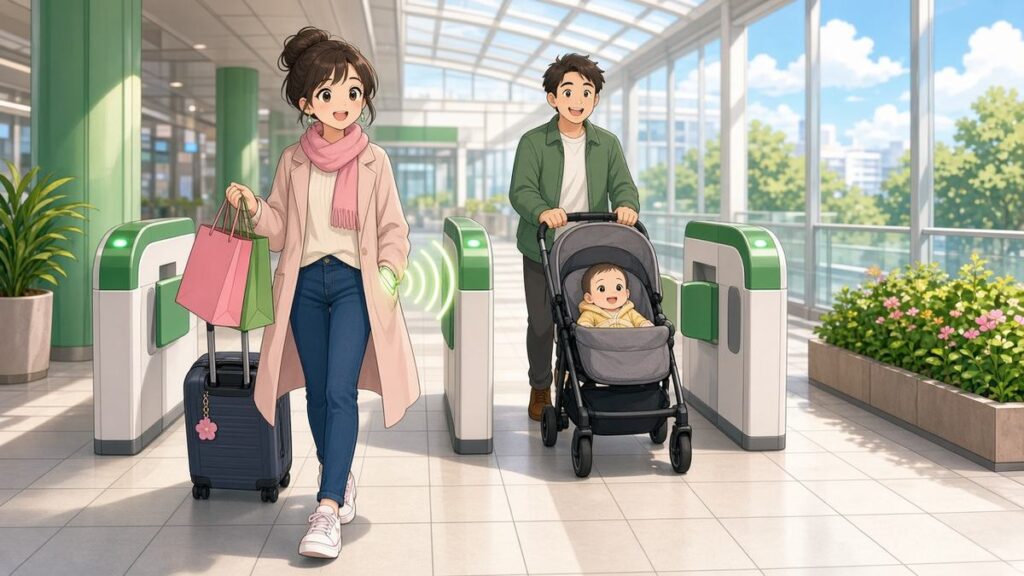
The company frames the project as part of turning Suica from a fare card into an everyday life device. For the passenger, the pitch is simpler: parents pushing strollers, wheelchair users and anyone with full hands no longer have to stop and fumble. If it works at Shinjuku at 8.30 on a Monday morning, it will work almost anywhere.