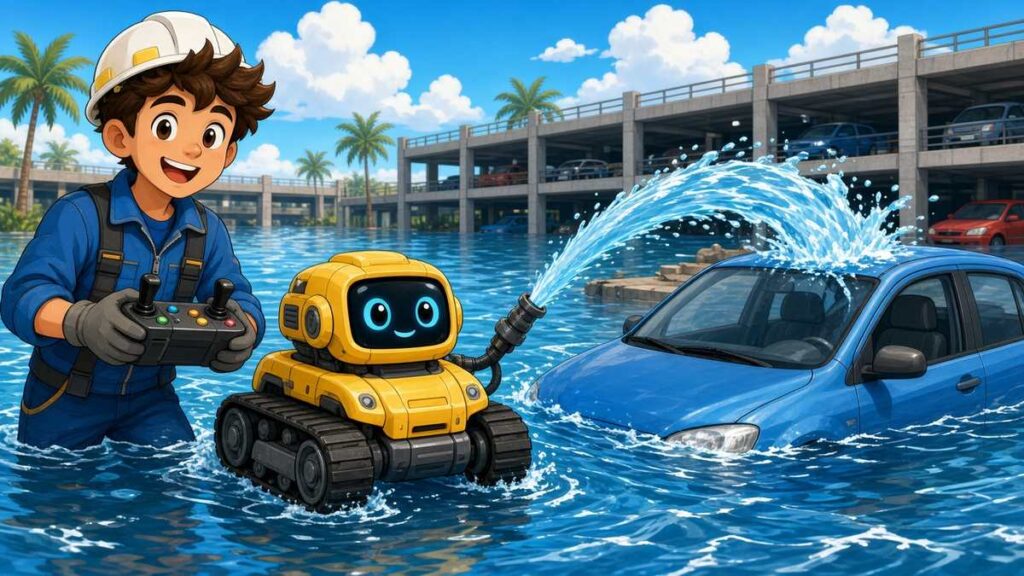
A Yellow Rover for the Basement: Singapore Sends a Robot Into Its Floodwater
Underground car parks are where flash floods turn dangerous. Water collects fast, pumps are hard to reach and, with electrical equipment nearby, sending people in can be a gamble. Singapore’s national water agency PUB now has a machine for exactly that job.
At the start of its third annual flood resilience campaign on November 12, PUB showed off a remote-controlled, amphibious pump vehicle — yellow, tracked and only slightly larger than a motorcycle, though it weighs about 800 kg. It can work in floodwater up to 70 cm deep, climb uneven ground and stairs, and run for at least seven hours. Its pumping capacity of 500 cubic metres an hour is enough to empty an Olympic-sized pool in roughly five hours, pushing the water into nearby drains while operators stay out of harm’s way.
The rover is leased and will be trialled for a year before PUB decides whether to deploy more.
The second new tool is less visible but arguably more useful day to day. PUB has installed 30 sensors along flood-prone roads, tucked behind drop inlet chambers at the kerb. Unlike the more than 1,200 water-level sensors already in canals and drains — which warn when channels reach 90 percent capacity, before anything has overflowed — the new ones report when water is actually pooling on the road.
The timing is deliberate. The north-east monsoon usually brings Singapore its wettest stretch from November to January, and the season has not officially begun. Yet heavy rain on November 10 had already flooded the junction of West Coast Road and West Coast Way. The message from PUB is simple: prediction is good, but when the water does arrive, it pays to know exactly where it is — and to have something other than a person to send into it.