Fifty-Two Barges, 2,200 Oars and 3.9 Kilometres: Inside Bangkok’s Royal Barge Procession
Most days the Chao Phraya is a working river: express boats, rice barges, tourists squinting at temples from a ferry deck. On the afternoon of Friday, November 6, it became something else for a few hours. Fifty-two ceremonial vessels, rowed by 2,200 personnel of the Royal Thai Navy, carried King Maha Vajiralongkorn and Queen Suthida downstream from Wasukri Pier to Wat Arun, the Temple of Dawn, while crowds packed both banks between the Rama VIII Bridge and the temple.
It was the Royal Barge Procession, one of the rarest public spectacles in Thailand, and it existed for a single purpose: to bring robes to monks.
Why robes, and why now
The ceremony at the heart of the day is Kathin, an annual Buddhist merit-making tradition held after the end of Buddhist Lent, when lay people present robes and other offerings to monastic communities. Ordinary Thai families and villages perform it every year. When the monarch presents the robes himself, it becomes a Royal Kathin — and on special occasions, the journey to the temple is made by water.
This year’s occasion was Queen Suthida’s fourth-cycle birthday. In Thai tradition a cycle is twelve years, so the fourth marks the 48th birthday, which fell on June 3, 2026. The robes were presented in her honour.
A formation measured in metres
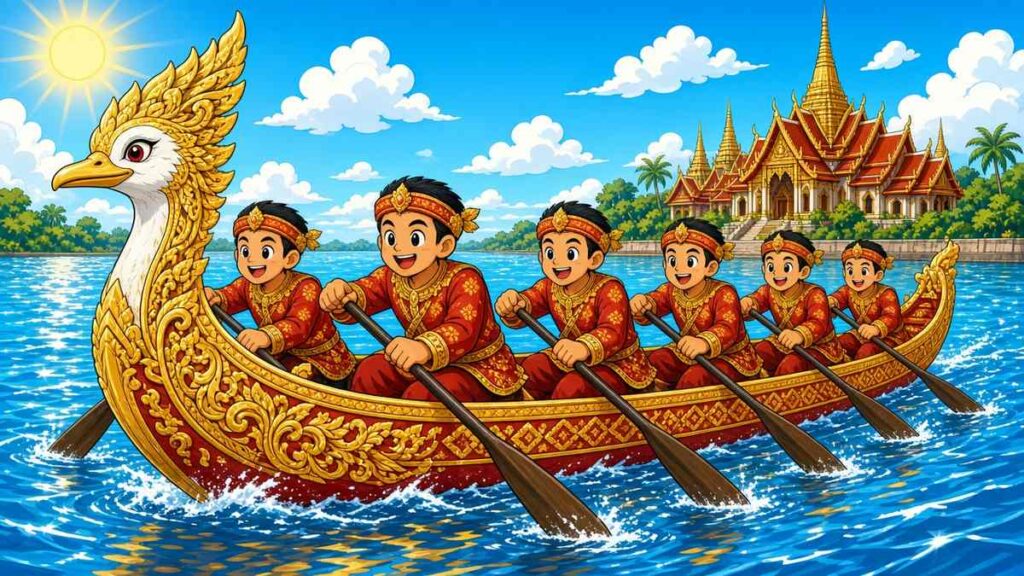
The fleet was arranged the traditional way: five columns in three lines, forming a moving block roughly 1.2 to 1.3 kilometres long and 90 metres wide. Four principal royal barges sat at its centre. The King and Queen travelled aboard the Suphannahong, the golden swan whose sweeping prow is perhaps the most photographed boat in the country; the vessel used today dates from late in the reign of King Rama V and was completed under Rama VI, replacing an older original. The Anantanakkharat, crowned with a multi-headed naga, carried the Kathin robes inside an ornate pavilion. The Narai Song Suban King Rama IX and the Anekkachatphutchong completed the quartet, surrounded by animal-figure barges and escorts.
The route — about 3.9 kilometres — follows the course used during the reign of King Bhumibol Adulyadej, passing Phra Sumen Fort, the Somdet Phra Pinklao Bridge, Siriraj Hospital, the Grand Palace and the Royal Thai Navy Auditorium before reaching Wat Arun’s landing. Along the way, drums, conch shells, horns and pipes sounded from the boats, and the oarsmen’s chanted boat songs set the rhythm.
Months of practice for one afternoon
None of this is improvised. The navy, the Bureau of the Royal Household and the Fine Arts Department restored and repaired the vessels, and rowing teams began rehearsing in mid-August. There were ten preliminary run-throughs and two full-dress rehearsals, the second on October 28. Tourism officials openly encouraged visitors to watch the rehearsals too, which gave many people their first sight of the fleet weeks before the real day.
The precision matters because the river does not cooperate. A procession of this size must hold its shape against current and tide while dozens of crews pull in time, and the barges must arrive in the right order at a narrow temple landing.
At the temple
Once at Wat Arun, officials carried the robes from the Anantanakkharat’s pavilion into the ordination hall. The King lit incense and candles before the temple’s principal Buddha image and presented the robes according to royal Buddhist custom. The royal party, accompanied by Princess Sirivannavari, Prince Dipangkorn and Chao Khun Phra Sineenat, then visited an exhibition titled “Wat Arun’s Prang: From Rattanakosin Identity towards World Heritage” — a hint at the temple’s ambitions beyond the day itself — and paid homage at the monument to King Rama II before returning to Dusit Palace.
Why it still draws crowds
For foreign visitors the barges are an extraordinary sight: gilded hulls, carved mythical creatures, rows of oars rising and falling in unison. For many Thais the day is something more layered, a meeting of monarchy, Buddhism and river life that the country stages only on significant occasions. Both kinds of spectator were on the banks on Friday. And when the last barge turned back upstream, the Chao Phraya went back to being a working river — until the next time it is asked to carry a kingdom’s ceremony.