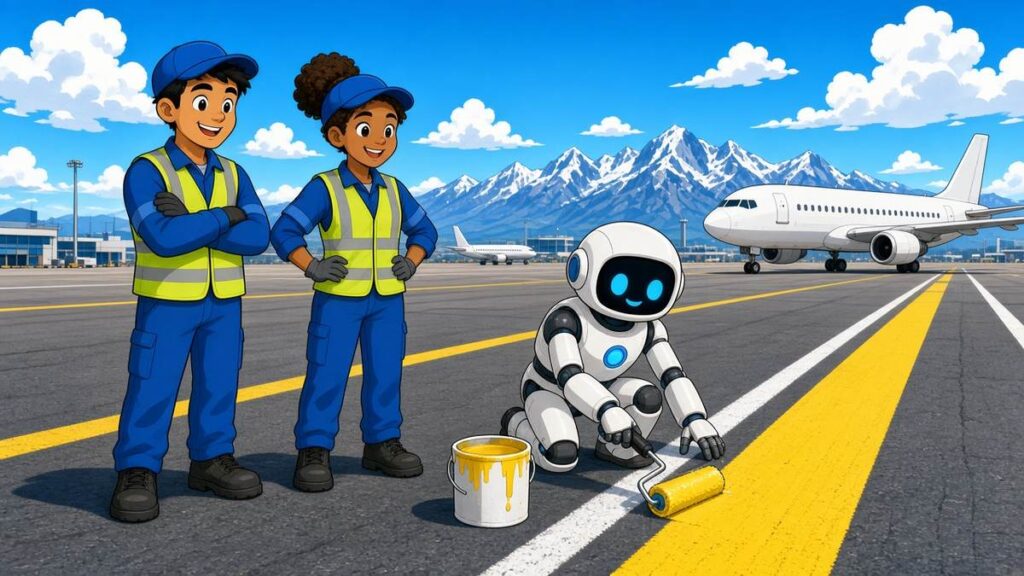
Two-Thirds Faster, Far Fewer Night Shifts: Hong Kong Airport Hands the Paintbrush to Robots
Every runway carries a quiet line of instructions painted onto its surface. The white stripes running down the centre tell pilots where to keep their wheels during take-off and landing, and they wear out faster than most travellers would guess: tyres, rubber deposits, jet blast and tropical rain all take their toll. Somebody has to repaint them, and at one of the world’s busiest cargo and passenger hubs that somebody is now partly a machine.
Hong Kong International Airport says it is the first airport anywhere to put robots on the job of repainting runway markings. The AI-guided machines, nicknamed “Brushman”, have cut the time needed to refresh the centre lines by roughly two-thirds compared with painting by hand.
A job built for the middle of the night
The old method was labour-intensive. Each runway has more than a hundred centre-line stripes, and repainting them used to require a crew of over twenty people. Because a runway can only be closed when traffic is light, that work happened in the small hours, on hands and knees or bent over stencils, often in heat and humidity.
The robots do not remove people from the process; they change what people do. Staff now supervise the machines rather than wield the rollers themselves, which the airport says makes the work both safer and more precise. A robot that follows a digital guide does not get tired at 3am, and it lays down a line that is straight to the centimetre.
Why time on the tarmac matters
For an airport, every minute a runway is shut is a minute of lost capacity. Shortening maintenance windows means the airfield can return to service sooner, or the same window can be used for more tasks. That matters at Hong Kong, which has been rebuilding traffic and recently opened its three-runway system, adding many more kilometres of markings that need regular care.
There is also a staffing angle that airports across Asia recognise. Ground handling and airfield maintenance have struggled to attract younger workers since the pandemic, and overnight manual labour is a hard sell. Automation that turns a gruelling job into a supervisory one may prove as useful for recruitment as for efficiency.
Small robots, bigger questions
Runway painting is a modest task, but it fits a broader pattern: airports are becoming test beds for robots that clean terminals, carry baggage and inspect pavements. The real test for Brushman will come over the next few monsoon seasons, when the airport will see whether robot-painted lines hold up as well as the ones laid down by hand. If they do, the night crews of other hubs may soon be swapping rollers for remote controls.