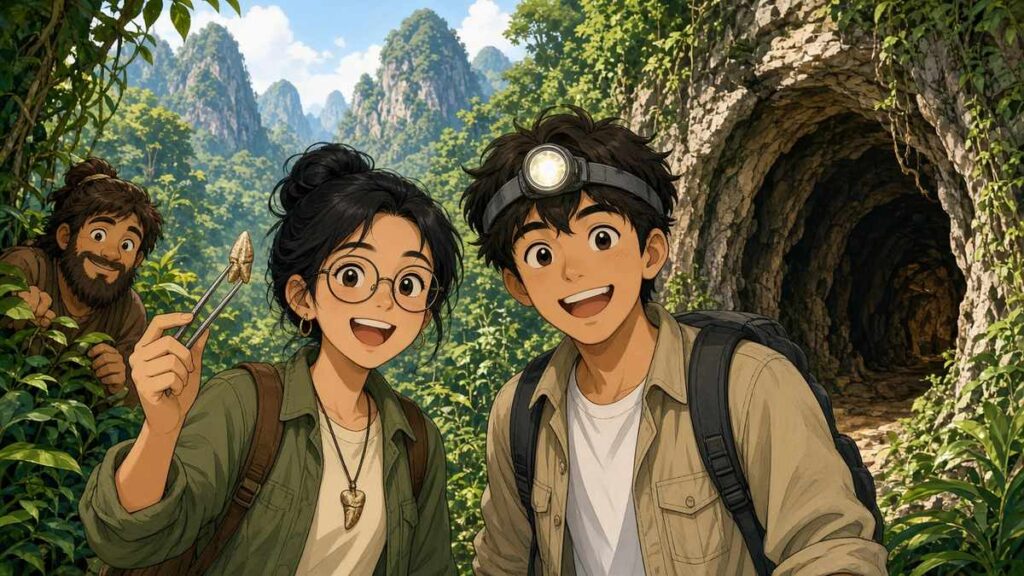
Nine Teeth From Two Caves: Homo Erectus Was Still at Home in China’s Rainforests 184,000 Years Ago
Some of the biggest stories in human evolution fit in the palm of a hand. In the limestone hills near Chongzuo, in southern China’s Guangxi region, researchers have recovered nine hominin teeth from two caves, Baxian and Naxian. Two papers published in Nature now argue that these small fossils change what we thought we knew about one of our most successful relatives.
A late survivor
Using several independent dating methods, the teams place the teeth between about 324,000 and 184,000 years ago. Eight of them were identified as Homo erectus, both from their shape and, where it could be tested, from ancient proteins preserved in the enamel. That combination matters: tooth shape alone can be ambiguous, but protein sequences give an extra, molecular check on which lineage a fossil belongs to.
The result points to a previously unknown late population of Homo erectus in mainland East Asia, surviving well after the species is often assumed to have faded from the region. Homo erectus first left Africa close to two million years ago, so a group still living in southern China less than 200,000 years ago underlines how long-lived and widespread it was.
Life under the canopy
Perhaps the most surprising finding concerns where these people lived. Chemical signatures in the teeth indicate a closed tropical rainforest environment. For a long time, dense rainforest was considered a difficult habitat that only Homo sapiens, with its complex tools and social networks, had learned to exploit. Food in such forests is scattered, seasonal and often hard to reach, and navigating thick canopy is very different from roaming open grasslands.
The Guangxi evidence suggests Homo erectus managed it too. That makes the species look less like a primitive forerunner and more like a flexible survivor that could adapt to very different landscapes over hundreds of thousands of years.
The odd tooth out
The ninth tooth is a mystery of its own. Catalogued as PA1796, it lacks the protein signature of Homo erectus and looks different. The researchers suggest it may belong to Homo longi, the group linked to the Denisovans, whose genes still survive in some people in Asia and Oceania today. If confirmed, it would mean two different kinds of humans lived in the same corner of southern China at roughly the same time.
That picture fits a growing consensus: Asia during the Middle Pleistocene was not home to a single human lineage moving steadily towards modern people, but to a crowded patchwork of populations. Each new cave in southern China seems to add another piece, and the Chongzuo teeth show that some of the most important pieces are also the smallest.