Slower When It’s Quiet, Faster at Rush Hour: Singapore Rebuilds 500 MRT Escalators
Most commuters notice an escalator only when it stops. Singapore is betting that a quiet, years-long rebuild of the machines that carry people between platforms and street level will mean far fewer of those moments. More than 500 escalators on four MRT lines are to be overhauled, the Land Transport Authority and the operators SMRT and SBS Transit announced on Wednesday.
A seven-year job, station by station
The first wave begins on December 17 and covers 290 escalators on the North-South, East-West and North East lines. It is scheduled to finish by the end of 2032. Familiar names are on the list: Woodlands, Sembawang, Toa Payoh and Orchard in the north and centre, Changi Airport, Tanah Merah and Tanjong Pagar in the east and south, and HarbourFront, Chinatown, Dhoby Ghaut, Serangoon, Sengkang and Punggol on the North East Line. A further 237 escalators on the Circle Line will follow at a later date.
The machines being replaced are between 15 and 30 years old; some have been running since 1996. Escalators at newer stations such as Canberra, Marina South Pier and the western stretch from Pioneer to Tuas Link do not need the work. Escalators linked to stations, for example at pedestrian overhead bridges, are included.
What riders will actually notice
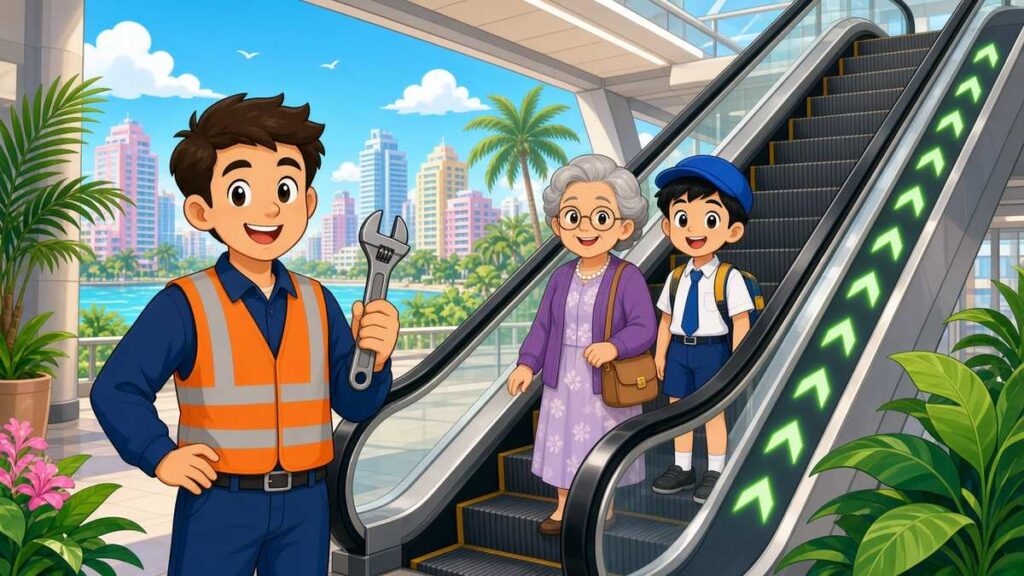
The rebuilt units get a built-in voice system for safety announcements, LED indicators that show the direction of travel at a glance, and brighter lighting. The more interesting change is about speed. The escalators will run at normal pace during peak hours to keep crowds moving, then slow down off-peak. That saves energy, but it also reflects a demographic reality: Singapore is ageing fast, and a gentler step speed makes a real difference to older riders, parents with prams and anyone unsteady on their feet.
Each escalator will be out of service for roughly four to five months while its motor, control equipment, steps, handrails and safety features are replaced. Where a station has several units due for work, the jobs will be staggered. At least one up escalator will keep running from platform to concourse, and lifts will remain available.
Building on an earlier round
This is not the network’s first large escalator programme. SMRT previously upgraded 231 escalators on the North-South and East-West lines in a six-year effort completed in 2022. The new phase includes 83 escalators on those lines that were not due for renewal back then.
Why it matters beyond the commute
For visitors, Singapore’s transit system is often the first impression of the city, and its reputation rests on small details working every day. Escalator breakdowns rarely make headlines elsewhere, but in a dense, rail-dependent city they ripple quickly into crowded platforms and missed connections. Planning the renewal years ahead, before ageing equipment starts failing, is the less glamorous side of the reliability that commuters have come to expect.
The trade-off is patience. Over the next several years, many travellers will meet barriers around a familiar escalator and take the stairs or a lift instead. The promise is that what reopens will be safer, smarter about its speed and kinder to the city’s oldest riders.