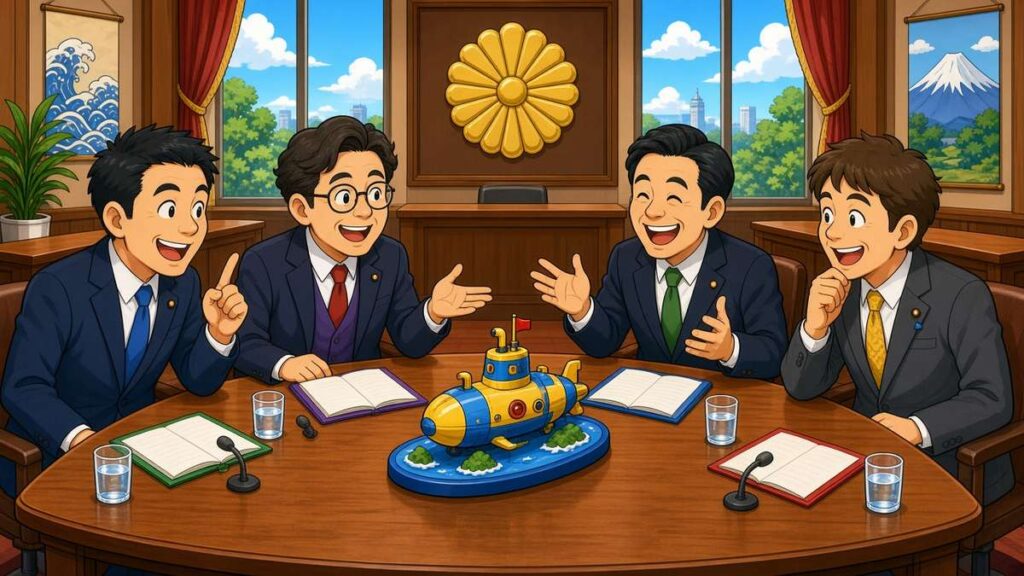
Japan’s Nuclear Submarine Question: Why an Old Taboo Is Back on the Table
For most of the post-war era, the phrase “nuclear-powered submarine” was something Japanese politicians avoided saying in public. The country that suffered atomic bombings built its security identity around restraint, and its laws confine nuclear energy to peaceful purposes. That silence is now breaking. Prime Minister Sanae Takaichi told parliament this month that her government will consider the idea “in a concrete and realistic manner”, and the issue has become one of the most contested items as Tokyo rewrites its core security documents before the end of the year.
Why now
The short answer is geography and endurance. Japan’s current submarines are among the most capable conventionally powered boats in the world, quiet and technologically advanced. But diesel-electric and lithium-ion submarines must surface or snorkel regularly and have limited range at high speed. Japan’s maritime interests stretch from the Sea of Japan to the East China Sea and deep into the western Pacific, where Chinese naval activity has grown steadily. A nuclear-powered boat can stay submerged for months and shadow other fleets over long distances.
Neighbours are also moving. Australia is pursuing nuclear-powered submarines through the AUKUS partnership, and South Korea has pressed hard for the same capability. For defence planners in Tokyo, the risk is of being the only major US ally in the region without a long-endurance undersea option.
Why the coalition is split
The governing partnership does not speak with one voice. Takaichi’s coalition partner, Nippon Ishin no Kai, wants Japan to move quickly and has even called for a realistic re-examination of the non-nuclear principles, particularly the pledge not to allow nuclear weapons into Japan. Many in the Liberal Democratic Party are more cautious. They see value in studying nuclear propulsion but worry about linking it to the far more sensitive question of nuclear weapons, which could alarm voters and neighbours alike.
That distinction matters. Nuclear propulsion uses a reactor to drive a vessel; it does not imply carrying nuclear arms. But the political debate in Japan rarely separates the two cleanly, and opponents argue that blurring the line is precisely the risk.
The practical hurdles
Even if the politics settle, the obstacles are formidable. Japan’s Atomic Energy Basic Act restricts nuclear energy to peaceful uses, and legal scholars disagree on whether naval propulsion fits that definition. The country would need highly trained reactor crews, new shipyard capabilities, secure fuel supply and a way to handle naval nuclear waste, an issue Japan has not even solved for its civilian power plants. Cost is another question: a single nuclear submarine programme can consume a large share of a defence budget that is already stretched by new missiles, drones and personnel shortages.
There is also the matter of partners. Japan would almost certainly need deep cooperation from the United States, and possibly from Britain or France, on reactor technology and highly enriched or low-enriched fuel. Such arrangements take years to negotiate and come with conditions.
What to watch
The realistic near-term outcome is a commitment to study, not to build. If the revised security documents include language on researching nuclear propulsion, that alone will be a historic shift in tone. The real test will come later, in budget requests, legal changes and whether the public accepts that a reactor under the sea is different from a bomb.
For a country that has long treated the word “nuclear” with deep caution, simply discussing the option openly says a great deal about how much its security environment has changed.