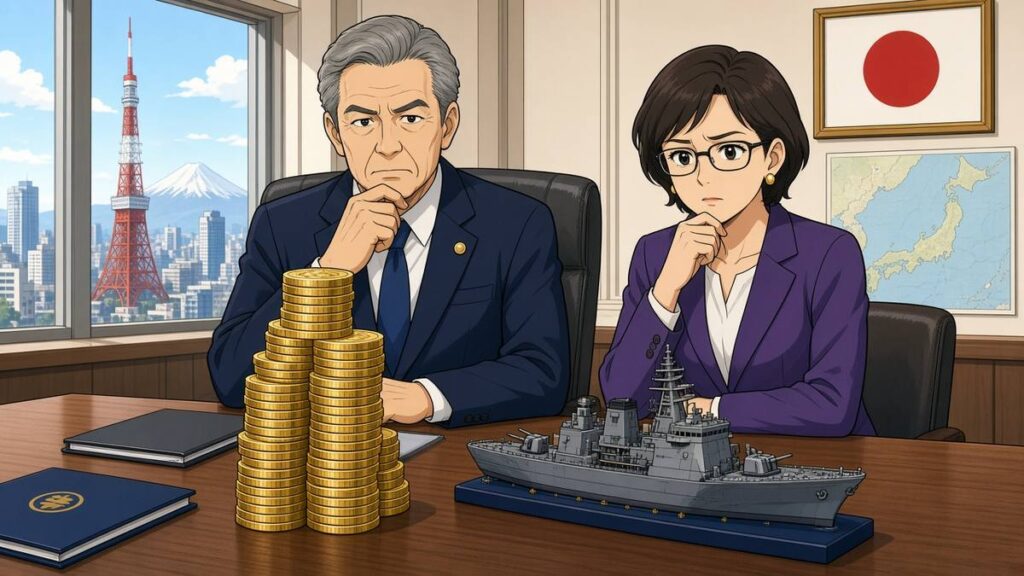
Fifty, Sixty or Eighty Trillion Yen: Tokyo’s Treasury Puts a Price Tag on Takaichi’s Defence Ambitions
Every government eventually reaches the point where a strategy meets a spreadsheet. In Japan, that moment appears to have arrived. Officials at the Finance Ministry have floated a five-year defence envelope of ¥50 trillion to ¥60 trillion for the period beginning in April 2027, according to people familiar with the internal discussions — a figure that sounds enormous until it is set beside what the hawks around Prime Minister Sanae Takaichi had in mind.
Three numbers, three camps
The current five-year programme, approved in 2022, runs to about ¥43 trillion. Some defence officials and lawmakers in the ruling Liberal Democratic Party have argued that the next plan should reach roughly ¥80 trillion. The treasury’s proposal lands in between: clearly more than today, clearly less than the wish list.
That gap is not an accounting footnote. Defence contractors have reportedly been warned to expect much smaller orders than they had planned for, and planned purchases of some missiles and aircraft — including American-built F-35 stealth fighters — could be cut by as much as half under the leaner scenario. For an industry that spent the past three years expanding production lines on the assumption of steady growth, that is a sharp change of tone.
Why the treasury is pushing back
The ministry’s argument is essentially about competing promises. Takaichi has pledged to spend heavily on economic growth and has pushed through a cut in the consumption tax on food, a move that alone is expected to leave a hole of about ¥4.3 trillion a year in government revenue. Ideas for filling it, including tapping foreign exchange reserves, remain contested. Finance officials say a much steeper climb in military spending on top of all that would be very hard to fund.
Finance Minister Satsuki Katayama has declined to engage on the specifics, saying the government’s advisory panel on security and defence has not yet discussed matters at that level of detail. That is a polite way of saying the fight has not been settled — only opened.
The pressure from outside
The timing is awkward. Washington’s 2026 National Defense Strategy calls on allies to spend 3.5% of GDP on their armed forces, with a further 1.5% on wider security needs. Tokyo is still working towards its own, much more modest target of 2%. A ¥50–60 trillion plan would, by most readings, leave Japan short even of that.
Meanwhile, the security environment that justified the 2022 build-up has not become calmer. Japan’s defence white papers continue to describe China’s military activity around the East China Sea and Taiwan as the country’s most serious strategic challenge, and North Korea’s missile programme shows no sign of slowing.
A fight inside the party
The proposal is therefore likely to meet fierce resistance from security-minded LDP lawmakers. One ruling-party official, speaking anonymously, put it bluntly: if the aim is to build the capabilities needed to deter a contingency that “could occur at any time,” a figure in the ¥50 trillion range is out of the question.
For Takaichi, the dispute is uncomfortable precisely because both sides are, in a sense, her own. Her political brand is built on a strong defence posture. Her economic programme is built on fiscal generosity and tax relief. The Finance Ministry is simply forcing the question of which comes first.
What to watch
The real decisions will come over the coming weeks as the government drafts the fiscal 2027 budget and the advisory panel prepares its recommendations. Three things will signal where the balance is tilting:
- The headline figure. Anything close to ¥60 trillion would be read as a compromise; anything near ¥50 trillion as a treasury victory.
- The shopping list. Whether big-ticket imports such as the F-35 are trimmed, or whether cuts fall on domestic programmes instead, will matter to both Washington and Japanese industry.
- The funding plan. A credible answer on how to pay — new taxes, spending cuts elsewhere or reserve funds — will determine whether any number survives contact with parliament.
Japan has spent the past few years telling its neighbours and its ally that it is serious about defence. The next few weeks will show how much it is willing to pay for that message, and who inside the government gets to decide.