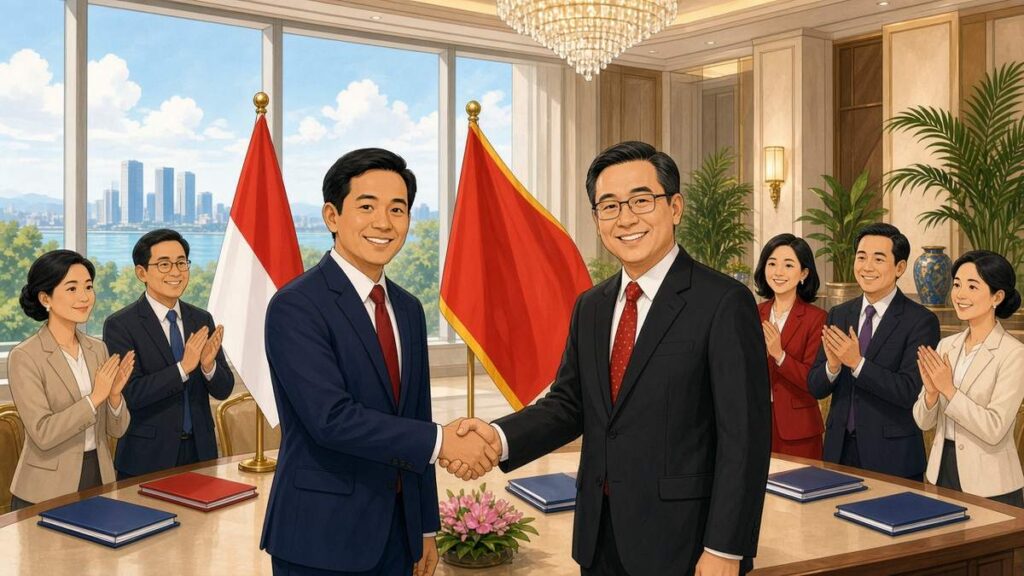
29 Deals in One Afternoon: What Singapore and China Agreed at Their Top Bilateral Forum
Singapore and China wrapped up the 22nd meeting of their Joint Council for Bilateral Cooperation (JCBC) on 23 November with a list of 29 agreements, the longest set of deliverables the forum has produced in recent years. The council, co-chaired by Deputy Prime Minister Gan Kim Yong and Chinese Vice Premier Ding Xuexiang, met for more than two hours at the Shangri-La hotel in Singapore.
The number itself tells a story. Last year’s session in Chongqing ended with 27 deals, and the 2024 meeting in Singapore with 25. A steadily rising count suggests that both governments still see plenty of practical ground to cover, even at a time when trade tensions and technology rivalry dominate much of the conversation about China in the wider region.
Services, not just goods
The most far-reaching item may be the least glamorous: a renewed memorandum of understanding on trade in services. Much of the attention in Singapore-China economic ties has traditionally gone to investment parks, ports and manufactured goods. The services pact points in a different direction, towards healthcare, eldercare, legal and professional services, where companies from both sides can partner and consumers can access new offerings.
For Singapore, a city-state whose economy runs heavily on services, this matters. For China, whose population is ageing quickly, eldercare and healthcare know-how are areas of growing demand.
Paying across borders, in seconds
In finance, the two sides are discussing a link between their fast payment systems for small-value transfers. Gan said such a connection could help commerce and tourism, and would complement the expanding number of renminbi payment channels between the two countries.
Anyone who has travelled between Singapore and Chinese cities knows why this is attractive. Daily life in China runs on mobile payments, while visitors often struggle with foreign cards and currency conversion. A direct link for small payments would make shopping, travel and family transfers simpler, and it would also give smaller businesses an easier way into the Chinese market.
Health and new technologies
Health agencies from both countries also signed a new agreement to support mutual exchanges and learning. Ding, for his part, called the meeting productive and urged deeper cooperation in emerging fields such as science and technology innovation, the digital economy, artificial intelligence and green industries.
Gan summed up the relationship as one that has stayed relevant by adapting to each new phase of development in both countries. Beneath the diplomatic language lies a pragmatic calculation: Singapore wants to remain a trusted partner for all the major powers, and the JCBC is one of the most regular, results-focused channels it has with Beijing.
The real test will come in the coming months, when memoranda have to be turned into working payment links, joint projects and services that ordinary people can actually use.