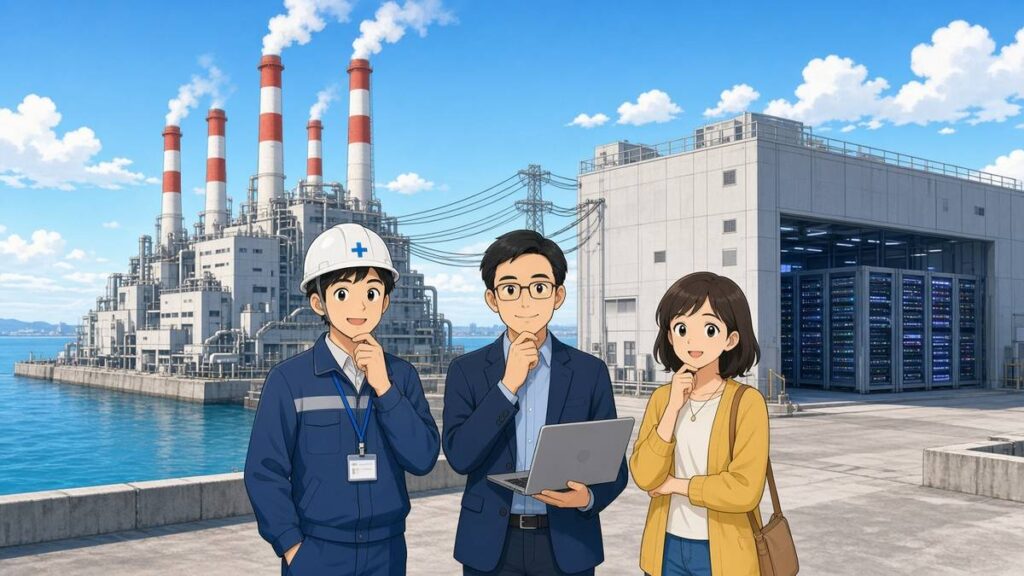
Plugging AI Straight Into the Power Station: JERA’s Bet on Behind-the-Meter Data Centres
Japan’s biggest power generator wants to cut out the middle of the grid. JERA, which produces roughly a third of the country’s electricity, is in talks with Anthropic, Meta and other American technology companies to build data centres right beside its power plants around Tokyo, according to a Nikkei report on Friday. Chief executive Yukio Kani said the group is also talking to Amazon, Microsoft and Google.
Why sit next to the chimney?
The idea is called “behind the meter”. Instead of drawing power from the public network, a data centre takes electricity directly from the generator next door. For tech companies the attraction is speed: in the Tokyo region, waiting for a large new grid connection can take years, while a site inside a power-station compound already has the cables, cooling water and land. For JERA, a long-term customer that buys enormous amounts of power around the clock is worth more than the uncertain prices of the wholesale market.
Chiba is the template
The plan builds on an agreement JERA signed in October with Dell Technologies and the British developer RHAELM. The three want a standard model for AI infrastructure on a national scale, starting with a hyperscale data centre of about 400 megawatts at the Chiba Thermal Power Station, an investment of around US$15 billion with operations targeted for 2028. Other JERA plants are to be studied for multi-gigawatt capacity in the 2030s. According to JERA, RHAELM handles marketing and is in talks with several large cloud operators.
The open questions
Most of JERA’s Tokyo Bay plants burn liquefied natural gas, so AI demand tied directly to them could lock in fossil generation just as Japan is trying to cut emissions. Data centres have also become a local issue: residents in places such as Kashiwa, north-east of Tokyo, already complain about towering windowless buildings and noisy backup generators next to their homes. Placing new halls on industrial land by the sea may ease that friction, but it raises questions about how much capacity is left for everyone else on cold winter evenings.
None of the companies named has confirmed a deal yet. Still, the direction is clear: in the race for AI computing power, the scarcest resource in Japan is not chips but connected electricity, and the firm that owns the turbines suddenly holds a strong hand.