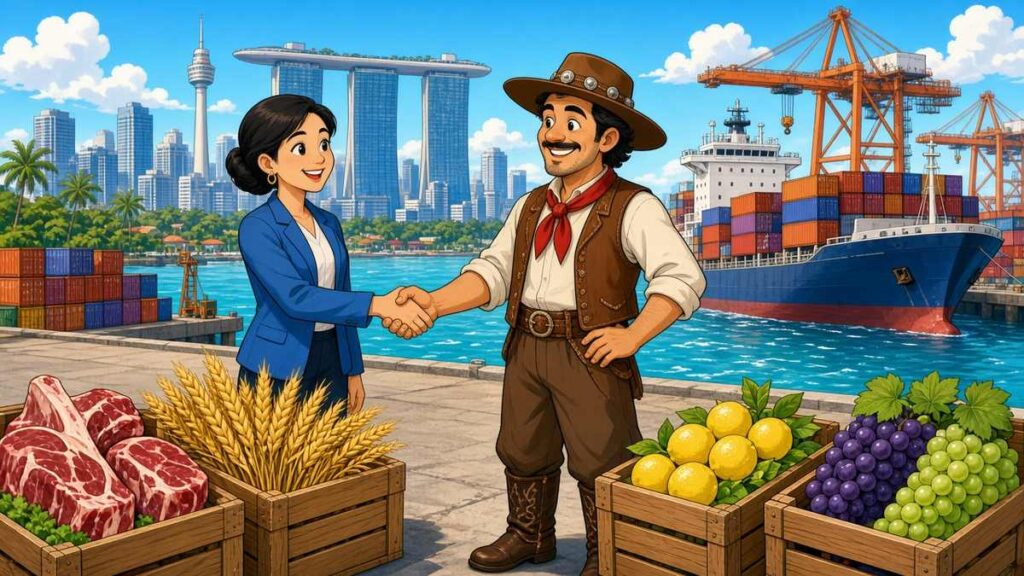
Harvests, Ports and a 15-Year Countdown: The Mercosur Deal Is Now Complete for Singapore
A city-state that imports most of its food has every reason to care about who grows it. That is the simplest way to understand why Singapore marked November 1 as a milestone: the Mercosur-Singapore Free Trade Agreement (MCSFTA) entered into force with Argentina, the last of the bloc’s four founding members to bring it into effect with Singapore.
A bloc, one partner at a time
Mercosur, the Southern Common Market, was founded in 1991 by Argentina, Brazil, Paraguay and Uruguay and covers a population of around 270 million people. The agreement with Singapore was already in force with Brazil, Paraguay and Uruguay. With Argentina now on board, Singapore’s businesses can treat the founding bloc as one connected market under a single set of rules.
What the numbers mean
Under the pact, Mercosur will remove import tariffs on about 96% of products over a period of up to 15 years. Roughly a quarter of tariff lines are tariff-free immediately. That structure matters: some sectors benefit from day one, while others open gradually as the long tariff schedule winds down.
The deal goes beyond tariffs. It sets common rules of origin, makes customs procedures more transparent, allows wider use of preferential tariff treatment and supports faster clearance of express shipments and perishable goods. For anyone shipping chilled food across oceans, the clause about perishables is not a footnote; it is the difference between a product that arrives fresh and one that does not.
Food resilience is the headline
In their joint statement, Singapore’s Ministry of Energy, Trade and Industry and the Argentine embassy pointed to Argentina’s role as a major agricultural and food producer, which supports Singapore’s goal of diversifying where its food comes from. Singapore has spent years spreading its food imports across many countries so that a drought, a disease outbreak or an export ban in one place does not empty supermarket shelves. A large producer on the other side of the world, with a different growing season and different risks, fits that strategy neatly.
The two sides also named energy, infrastructure, logistics, technology and services as areas of opportunity. In the other direction, Argentine businesses can use Singapore as a regional hub to reach South-east Asia.
More than goods
The agreement also promises more certainty and transparency for service suppliers and investors, along with cooperation on entrepreneurship, digitalisation, cybersecurity, sustainable development and small and medium-sized enterprises. It builds on the Pacific Alliance-Singapore Free Trade Agreement, which entered into force in 2025, giving Singapore a growing network of formal links across Latin America.
None of this changes prices overnight. Trade agreements work slowly, through contracts, supply chains and companies deciding that a new route is worth the effort. But for a country that cannot grow much of its own food, each new reliable source is a form of insurance, and November 1 added one more.